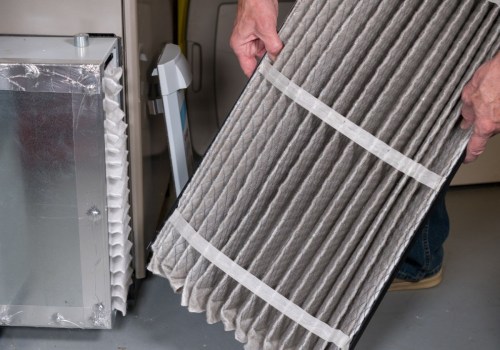
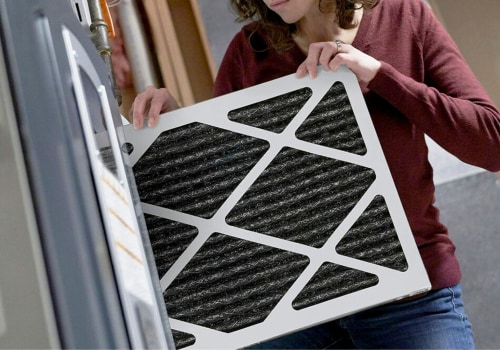
Don't take your indoor air for granted during allergy season — pollen doesn't stop at your front door. It travels through every HVAC return vent in your home, and if your filter isn't rated to stop it, you're recirculating the very particles triggering your symptoms.
Here's what most homeowners don't realize: knowing when is allergy season matters, because not all MERV ratings filter pollen equally once those allergens start building outdoors and drifting inside. After manufacturing air filters for over a decade and working with more than two million households, we've found that a MERV 11 is the sweet spot for most allergy sufferers — capturing the fine pollen particles a MERV 8 lets slip through, without the airflow strain of a MERV 13 on systems not built for it. For severe allergy households, MERV 13 is the stronger shield.
This page gives you the straight answer on which MERV rating fits your situation, why particle size is the number that actually matters, and how to make the right call for your home and your HVAC system.
TL;DR Quick Answers
When Is Allergy Season?
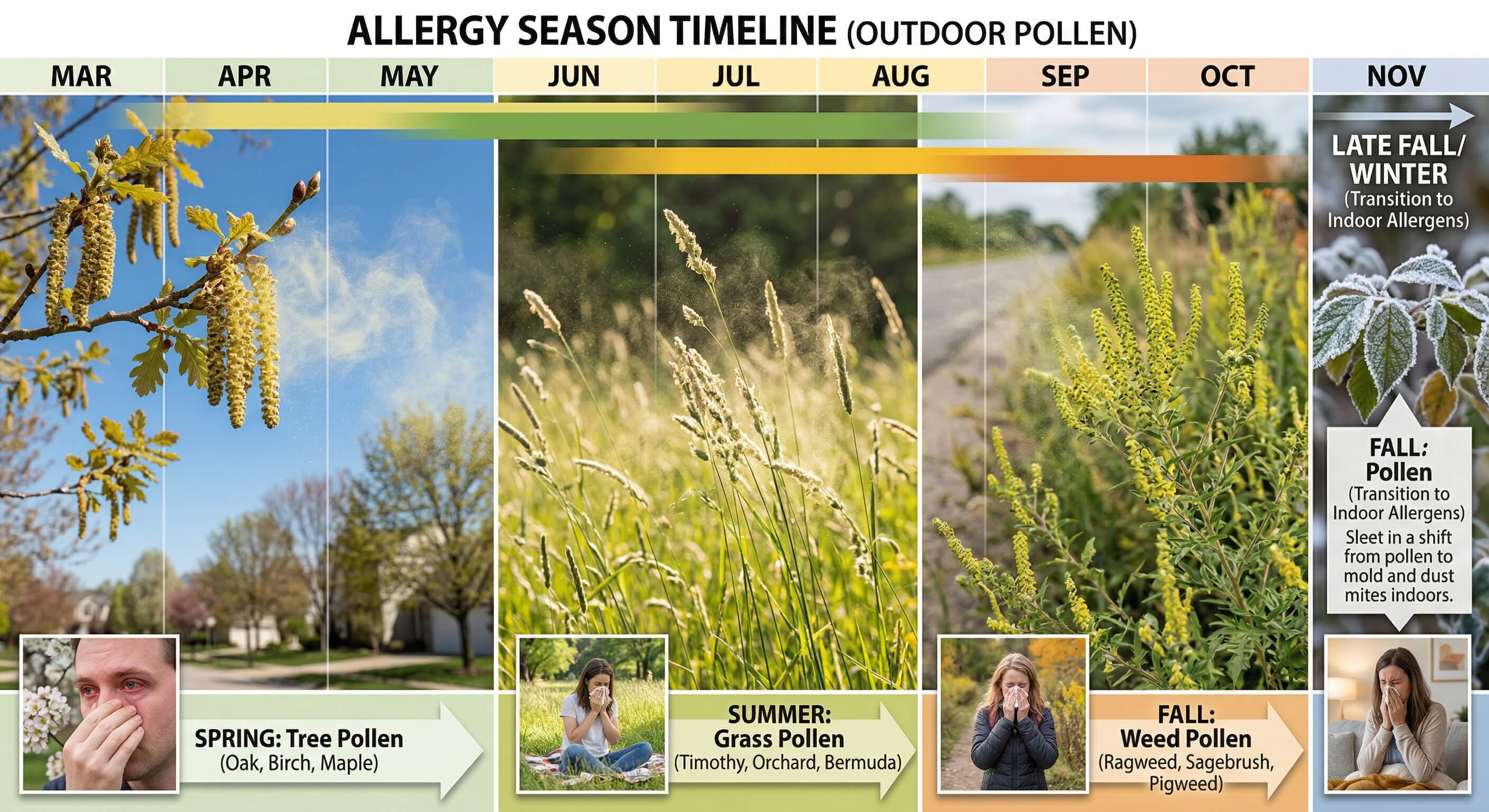
Allergy season in the U.S. doesn't have a single start or end date — it runs differently by region, pollen type, and year. Here's the fast breakdown:
Tree pollen season: January–May (starts earlier in the South, later in the North)
Grass pollen season: May–July nationwide
Weed and ragweed season: August–November in most regions
Total exposure window: 6–10 months depending on where you live
For most U.S. households, meaningful pollen exposure begins as early as January in the Southeast and doesn't end until the first hard frost — which is arriving later every year. Airborne pollen has increased 46% over a single decade and pollen seasons have lengthened by up to 27 days in parts of the northern U.S., meaning the allergy season most households are preparing for is shorter than the one they're actually living through.
The bottom line: if your symptoms feel relentless, it's likely because your season never fully stopped. A MERV 11 or MERV 13 filter — changed every 30–60 days during peak months — is the most direct way to control what allergy season does inside your home, even when you can't control what it does outside.
Top Takeaways
MERV 11 is the allergy season baseline — not a luxury. MERV 8 lets fine grass and ragweed pollen pass through with little resistance. MERV 11 captures the full spectrum of common pollen types. MERV 13 is the stronger shield for severe sufferers — but verify your system's static pressure rating before upgrading.
The allergy season is longer and more intense than it used to be. Airborne pollen increased 46% in a single decade. Pollen seasons have lengthened by up to 27 days in parts of the U.S. The change schedule that worked five years ago is increasingly underspec'd for current conditions.
Your HVAC system is either filtering pollen or recirculating it. There is no neutral outcome. Every system cycle either traps the pollen that entered through doors, windows, and return vents — or pushes it back through your living spaces. Your MERV rating determines which one happens.
The right MERV rating only works on the right change schedule. A clogged filter underperforms regardless of its rating. Shorten your interval during peak season:
MERV 11: every 45–60 days
MERV 13: every 30–45 days
High-pollen regions: lean toward the shorter end of each range
Your regional pollen calendar matters more than the national average. Tree pollen starts as early as January in the Southeast. Ragweed persists through November in warmer climates. Knowing when your local season peaks — not the average — is what keeps your home protected during the weeks your filter works hardest.
Why Pollen Size Is the Only Number That Matters
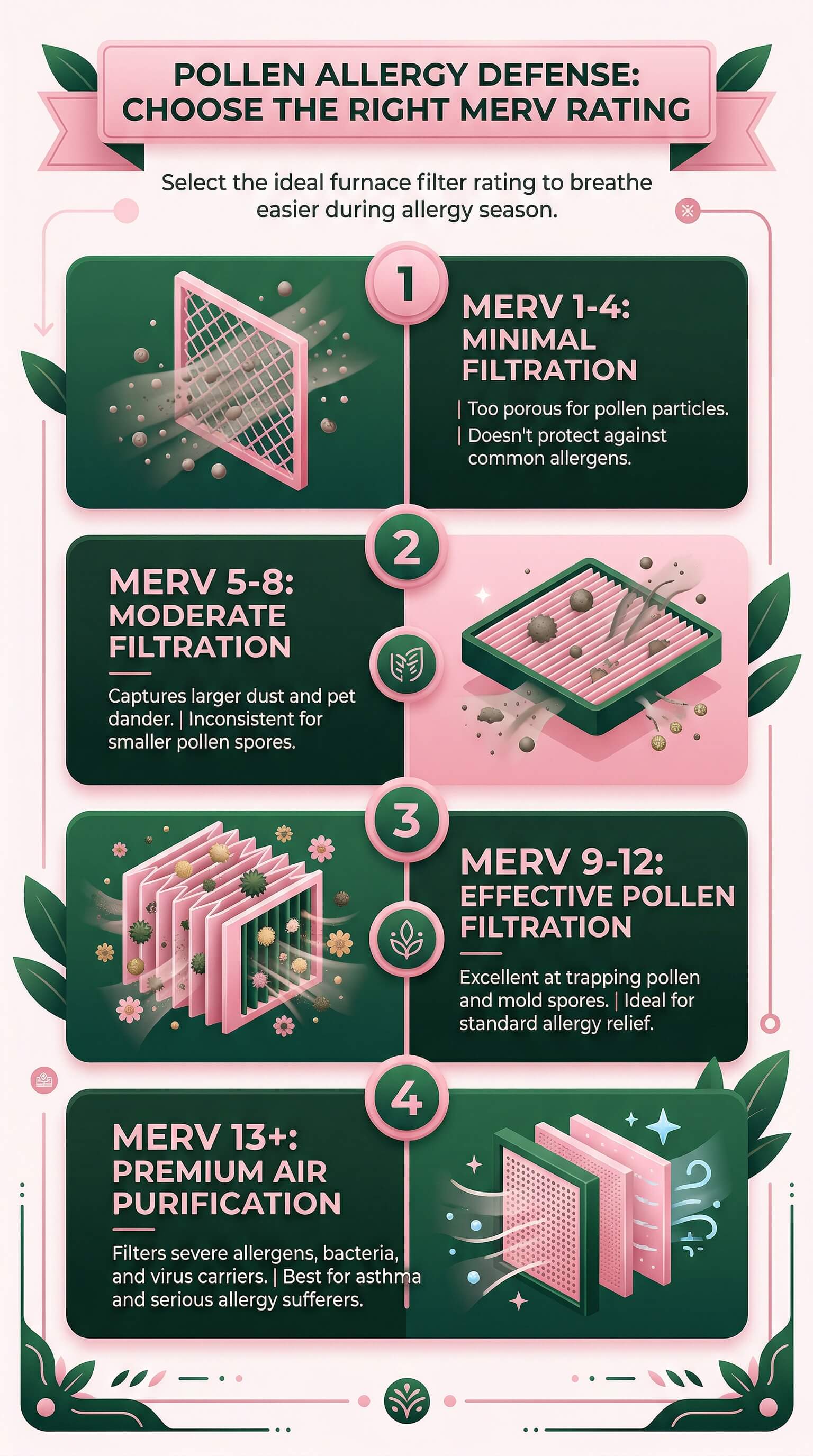
Pollen particles range from about 10 to 100 microns in size — large enough for higher-rated filters to capture reliably, but small enough that an underperforming filter lets them pass straight through and recirculate through your home's air supply. Understanding pollen's particle size is what makes the MERV rating decision straightforward: the rating tells you exactly where a filter's capture capability begins and ends.
MERV stands for Minimum Efficiency Reporting Value. It measures how effectively a filter removes airborne particles at specific size ranges. The higher the rating, the finer the particles a filter can trap — but the right rating isn't always the highest one. It's the one that matches both your air quality needs and your HVAC system's design.
MERV 8: Basic Protection, Limited Pollen Defense
A MERV 8 filter handles larger airborne debris well — dust, lint, and coarse pollen grains from trees like oak and pine. But finer pollen particles from grasses and ragweed, which fall in the 10–20 micron range, can move through a MERV 8 with little resistance. In our experience manufacturing filters for allergy-prone households, MERV 8 is a starting point — not a solution — for anyone dealing with seasonal symptoms.
Best for: Households without allergy sensitivities looking for standard air quality maintenance.
MERV 11: The Allergy Season Standard
A MERV 11 filter is where meaningful pollen protection begins. At this rating, filters capture particles down to 1 micron, which covers the full spectrum of common pollen types — including the fine grass and weed pollen that trigger the worst allergy responses. After working with millions of allergy-affected households, we consistently find that upgrading from a MERV 8 to a MERV 11 produces the most noticeable improvement in indoor symptom relief during peak season.
Best for: Households with mild to moderate seasonal allergies, homes with children, or anyone who notices symptoms worsening indoors during spring and fall.
MERV 13: Maximum Pollen Capture for High-Sensitivity Households
A MERV 13 filter captures particles as small as 0.3 microns — well beyond what pollen filtration requires, but the higher density media also traps pollen-attached particles like mold spores and fine dust that compound allergy symptoms. The important caveat: MERV 13 filters are denser, which creates more airflow resistance. Not every residential HVAC system is built to handle that static pressure. Running a MERV 13 in an underpowered system can strain the blower motor and reduce system efficiency over time.
Best for: Households with severe allergies or asthma, multi-pet homes, or any system rated to handle higher static pressure loads.
How to Know If Your System Can Handle a Higher MERV Rating
Upgrading your MERV rating is only beneficial if your HVAC system can support the increased filtration density. Here's what to check before making the switch:
Review your HVAC manual or manufacturer spec sheet for the recommended MERV range
Check that your filter slot fits the correct filter thickness for your chosen MERV level
Monitor your system's airflow after the upgrade — reduced output from vents is a sign the filter is too restrictive
Change filters more frequently during peak pollen season to prevent clogging and pressure buildup
How Often to Change Your Filter During Allergy Season
Filter change intervals matter as much as MERV rating during allergy season. A clogged filter — regardless of its rating — loses its capture efficiency and forces your HVAC system to work harder. In our experience, allergy season demands a shorter replacement cycle than the standard 90-day interval most homeowners follow:
MERV 8: Every 60 days during peak season
MERV 11: Every 45–60 days during peak season
MERV 13: Every 30–45 days during peak season
Homes in high-pollen regions, or with multiple allergy sufferers, should lean toward the shorter end of each range.
"One of the most consistent patterns we see — after manufacturing filters for over a decade and working with more than two million households — is that allergy sufferers tend to underestimate their filter. They're running a MERV 8 and wondering why their symptoms don't improve indoors. What they don't realize is that the fine pollen particles causing the worst reactions are exactly the ones a MERV 8 is least equipped to stop. The upgrade to MERV 11 isn't a luxury for allergy households — it's the baseline. And for severe sufferers, MERV 13 is where real relief begins. But here's what most people overlook: the rating on the filter only works if the filter itself isn't clogged. During peak pollen season, a neglected filter loses its efficiency faster than at any other time of year. The right MERV rating and the right change schedule — that combination is what actually protects your family's air."
Essential Resources
Most homeowners don't realize that allergy season in the U.S. can run from January through October — and that the pollen entering your home through every HVAC return vent is the same pollen triggering your symptoms indoors. After manufacturing filters for over a decade and serving more than two million households, we've learned that knowing when your local allergy season peaks is just as important as knowing which MERV rating to use. These seven authoritative resources give you the full picture.
What you'll find below:
When allergy season starts and ends by region and pollen type
Real-time pollen tracking tools used by allergists nationwide
Federal health data on why allergy seasons are getting longer and more intense
City-by-city rankings of the most challenging places to live with seasonal allergies
1. Your Starting Point for U.S. Pollen Season Timing Asthma and Allergy Foundation of America (AAFA) https://aafa.org/allergies/types-of-allergies/pollen-allergy/
If you only read one resource, make it this one. The AAFA breaks down U.S. pollen seasons month by month — tree pollen starting as early as February, grass pollen through summer, ragweed persisting into November — and explains exactly which filters carry their Certified Asthma & Allergy Friendly® designation. It's the foundation for every filter decision you'll make this season.
2. Why Your Allergy Season Feels Longer Than It Used To Centers for Disease Control and Prevention (CDC) https://www.cdc.gov/climate-health/php/effects/allergens-and-pollen.html
This isn't in your head. The CDC documents how warmer temperatures, fewer frost days, and elevated CO2 are pushing pollen season start dates earlier and end dates later every year. If your MERV 8 filter used to be enough and suddenly it isn't, this is the resource that explains why the season itself has changed — not just your sensitivity to it.
3. The Federal Health Recommendation That Points Directly to Your HVAC Filter Centers for Disease Control and Prevention (CDC) https://www.cdc.gov/climate-health/php/effects/pollen-health.html
The CDC explicitly recommends high-efficiency HVAC filters as a frontline defense against indoor pollen exposure. This is the authoritative third-party validation that makes upgrading your MERV rating a health decision, not just a product preference. We've seen this recommendation reflected in the households we serve — the ones who upgrade their filter are the ones who stop sneezing indoors.
4. The Science Behind Rising Pollen Counts National Institute of Environmental Health Sciences (NIEHS) https://www.niehs.nih.gov/health/topics/agents/allergens/pollen
NIEHS-funded research shows annual airborne pollen amounts increased 46% between 1994 and 2010, with pollen seasons lengthening by up to 27 days across parts of the U.S. This is the peer-reviewed federal data behind what millions of allergy households are experiencing firsthand — and why the filter that was sufficient five years ago may no longer protect your family the way it once did.
5. Check What's Actually in the Air Where You Live — Right Now American Academy of Allergy, Asthma & Immunology (AAAAI) https://pollen.aaaai.org/
The AAAAI's National Allergy Bureau runs the only certified national pollen tracking network in the country. Before you decide how aggressively to filter or how frequently to change your filter this season, check this tool. Real-time pollen counts by location tell you when your HVAC system is working its hardest — and when your filter is closest to capacity.
6. Understanding What Pollen Count Numbers Actually Mean American Academy of Allergy, Asthma & Immunology (AAAAI) https://www.aaaai.org/tools-for-the-public/conditions-library/allergies/hay-fever-and-pollen-counts
Knowing that today's pollen count is "high" is only useful if you understand what that means for your indoor air quality decisions. This expert-reviewed AAAAI resource translates pollen count data into actionable guidance — so you know when to shorten your filter change interval, when to keep windows closed, and when your household is most at risk.
7. Find Out How Severe Allergy Season Is Where You Live Asthma and Allergy Foundation of America (AAFA) https://aafa.org/wp-content/uploads/2026/03/aafa-2026-allergy-capitals-report.pdf
AAFA's 2026 Allergy Capitals Report scores the 100 most-populated U.S. metro areas on tree, grass, and weed pollen levels — giving you a precise, data-backed picture of how challenging your local allergy season is compared to the rest of the country. If your city ranks in the top tier, your filter change schedule during peak season should reflect that. This is the most current and comprehensive geographic resource available.
These resources show that allergy season is longer, more intense, and more localized than most homeowners realize — which is why knowing your peak pollen periods and using properly fitted air filters is essential for reducing indoor exposure and protecting your home during the worst parts of the season.
Supporting Statistics
Most people think of allergy season as a spring problem. After manufacturing filters for over a decade and serving more than two million households, we know the reality is more complicated — and more costly to your indoor air quality than the calendar suggests. The federal data below puts hard numbers behind what we see reflected in filter loads, change intervals, and MERV upgrade requests every single season.
1 in 4 U.S. Adults Has a Diagnosed Seasonal Allergy — But the Undiagnosed Are Managing Symptoms Through Their HVAC System Without Knowing It.
Approximately 25.2% of U.S. adults reported a diagnosed seasonal allergy in 2024, per the CDC's National Center for Health Statistics. That's roughly one person per household. But the more telling pattern in our experience isn't the diagnosis — it's the millions more self-treating with antihistamines who've never connected their persistent indoor symptoms to an unchanged filter. The households that make the biggest leap in indoor relief are rarely the ones who already knew they had allergies. They're the ones who assumed they didn't.
1 in 4 U.S. adults has a diagnosed seasonal allergy
Millions more manage symptoms without a formal diagnosis
Unrecognized indoor exposure is often a filter problem, not just a pollen problem
Source: CDC National Center for Health Statistics, 2024 National Health Interview Survey https://www.cdc.gov/nchs/pressroom/releases/20260108.html
Airborne Pollen Increased 46% in a Single Decade. The Filter Rated for Last Year's Season May Already Be Underspec'd for This One.
NIEHS-funded research documented a 46% increase in annual average daily airborne pollen between 1994–2000 and 2001–2010. Pollen seasons also lengthened by as much as 13 to 27 days in the northern U.S. between 1995 and 2009. We see this shift play out directly in demand patterns — year over year, more households that previously relied on MERV 8 are moving to MERV 11 and MERV 13. Not because their sensitivity changed. Because the pollen load their system is processing has.
46% increase in annual airborne pollen over a single decade
Pollen seasons lengthened up to 27 days in northern states
MERV 8 filters are increasingly underspec'd for current pollen conditions
Source: National Institute of Environmental Health Sciences (NIEHS) https://www.niehs.nih.gov/health/topics/agents/allergens/pollen
Ragweed Season Has Added More Than 3 Weeks of Exposure in Some Northern Cities. Most Households Are Still Changing Filters on the Old Schedule.
EPA data shows ragweed pollen season has grown longer at 10 of the 11 U.S. locations studied since 1995. The increases are significant:
21 additional days in Fargo, North Dakota
18 additional days in Minneapolis, Minnesota
Longer seasons recorded at 10 of 11 monitored locations nationwide
That's nearly a month of additional high-pollen exposure most filter change schedules don't account for — a seasonal shift that deserves the same level of attention many households give hurricane season. In our experience, the back end of fall is where allergy households go unprotected longest — not because they don't care, but because they're operating on seasonal assumptions the data no longer supports.
Source: U.S. Environmental Protection Agency, Climate Change Indicators: Ragweed Pollen Season https://www.epa.gov/climate-indicators/climate-change-indicators-ragweed-pollen-season
60 Million Americans Experience Allergic Rhinitis Annually. For Most, Their HVAC System Is Either the Solution or the Source.
Allergic rhinitis affects up to 60 million people in the U.S. annually, according to the CDC. Most allergy sufferers focus on outdoor exposure. What they don't realize is that every HVAC cycle is either filtering the pollen that drifted in through doors, windows, and return vents — or recirculating it. After working with millions of households on exactly this problem, our most consistent finding is straightforward:
The right MERV rating, changed on the right schedule, is the single highest-impact change most allergy households haven't made yet
Source: CDC Climate and Health — Allergens and Pollen https://www.cdc.gov/climate-health/php/effects/allergens-and-pollen.html
Final Thoughts
Allergy season doesn't end when the calendar says it should — and for most households, neither does the exposure. The pollen moving through your return vents during peak season is the same pollen your antihistamines are working against. The difference between a home that recirculates that load and one that traps it comes down to a single number stamped on your filter.
After manufacturing air filters for over a decade and working with more than two million households, the pattern is consistent: most allergy households aren't losing the battle outdoors. They're losing it indoors — to a filter that was never rated for the fight they're in.
What we've seen firsthand, and what federal data now confirms:
Pollen seasons are longer and pollen loads are heavier than they were a decade ago
A 46% increase in airborne pollen isn't a footnote — it's a mandate to recalibrate
The homes best protected made a deliberate choice to match their filtration to current conditions, not the conditions of five years ago
Our honest opinion on MERV ratings for allergy households:
MERV 11 is the baseline — not an upgrade. It's the minimum standard for meaningful indoor protection during spring and fall.
MERV 13 earns its place in households where symptom severity justifies the additional static pressure — provided the system can support it.
No rating outperforms a clogged filter. The change schedule is half the equation, and it's the half most homeowners skip.
The outdoor pollen count, the length of ragweed season in your region, the climate trends driving longer exposure windows — none of that is in your hands. Your MERV rating and your replacement schedule are. That's where we'd focus.
FAQ on When Is Allergy Season
Q: When does allergy season start and end in the U.S.?
A: It depends on where you live. Regional timing matters more than any national average.
Southeast and South Central U.S.: tree pollen arrives as early as January
Northeast and Midwest: pollen season typically begins March or April
Grass pollen: May through July nationwide
Ragweed: August through November in warmer climates
The households that struggle most aren't reacting to one season. They're caught in back-to-back pollen windows with no break between them. Your regional calendar — not the national average — determines when your HVAC filter is under its heaviest load.
Q: Is spring the worst time of year for allergies?
A: Spring gets the most attention. But it isn't automatically the worst season for every household.
Tree pollen hits hardest in spring after months of zero pollen exposure
The immune response is more intense because it arrives without warning
The most persistent sufferers cycle through tree, grass, and weed pollen back to back
If symptoms feel year-round, the problem is likely overlapping seasons — not a single spring spike. That requires a year-round filter change schedule, not just a seasonal one.
Q: Why does allergy season seem to be getting worse every year?
A: Because it genuinely is. The data and the demand patterns we see confirm it.
Airborne pollen increased 46% over a single decade (NIEHS)
Pollen seasons lengthened by up to 27 days in parts of the northern U.S.
Year over year, more households are moving from MERV 8 to MERV 11 and MERV 13
Not because their allergies changed. Because the pollen load their system is processing has. A MERV rating calibrated to conditions from five years ago is increasingly a mismatch for what households face today.
Q: How does allergy season affect indoor air quality?
A: More than most people expect. The entry point most households overlook is the HVAC return vent.
Pollen enters through doors, windows, clothing, and pets
The return vent pulls outdoor air — and pollen — inside every time the system cycles
Your filter either captures that pollen or recirculates it
There is no neutral outcome
What we've found across millions of households: indoor pollen exposure during peak season is consistently underestimated. The filter is either past its change interval, rated too low, or both. Fixing that is faster and less expensive than most interventions allergy households try first.
Q: What can I do at home to reduce exposure during allergy season?
A: The steps that move the needle most are also the simplest to implement. Here's what consistently produces the most relief across every major U.S. pollen region:
Upgrade to MERV 11 as your allergy season baseline
Use MERV 13 for severe sufferers or high-sensitivity homes
Shorten your change interval to every 30–60 days during peak season
Keep windows and doors closed during early morning peak pollen hours
Shower and change clothes after outdoor exposure
Monitor live local pollen counts at pollen.aaaai.org
The most common gap we see: households upgrade their MERV rating but keep the old change schedule. A clogged MERV 13 underperforms a fresh MERV 8. The rating and the interval only work together — not independently.
Now That You Know Which MERV Rating Filters Pollen During Allergy Season, It's Time to Put It to Work
Now that you know which MERV rating your household needs to filter pollen during allergy season, the only step left is making sure the right filter is in your system before your local season peaks. Shop Filterbuy's MERV 8 filters — American-made, available in over 600 sizes, and shipped free — and start protecting your family's air today.