TL;DR Quick Answers
20x20x1 air filter
A 20x20x1 air filter is the most common 1-inch residential HVAC slot size in the U.S. Actual dimensions run 19.5" x 19.5" x 0.75", and the slot fits standard return-air vents in homes between 1,200 and 2,000 square feet. In our experience, the MERV rating in that slot does more work than the size specification itself.
Actual size: 19.5" x 19.5" x 0.75" (nominal 20x20x1)
MERV 8: Standard residential. Catches dust, lint, and pollen.
MERV 11: Allergy-friendly. Adds pet dander and mold spores.
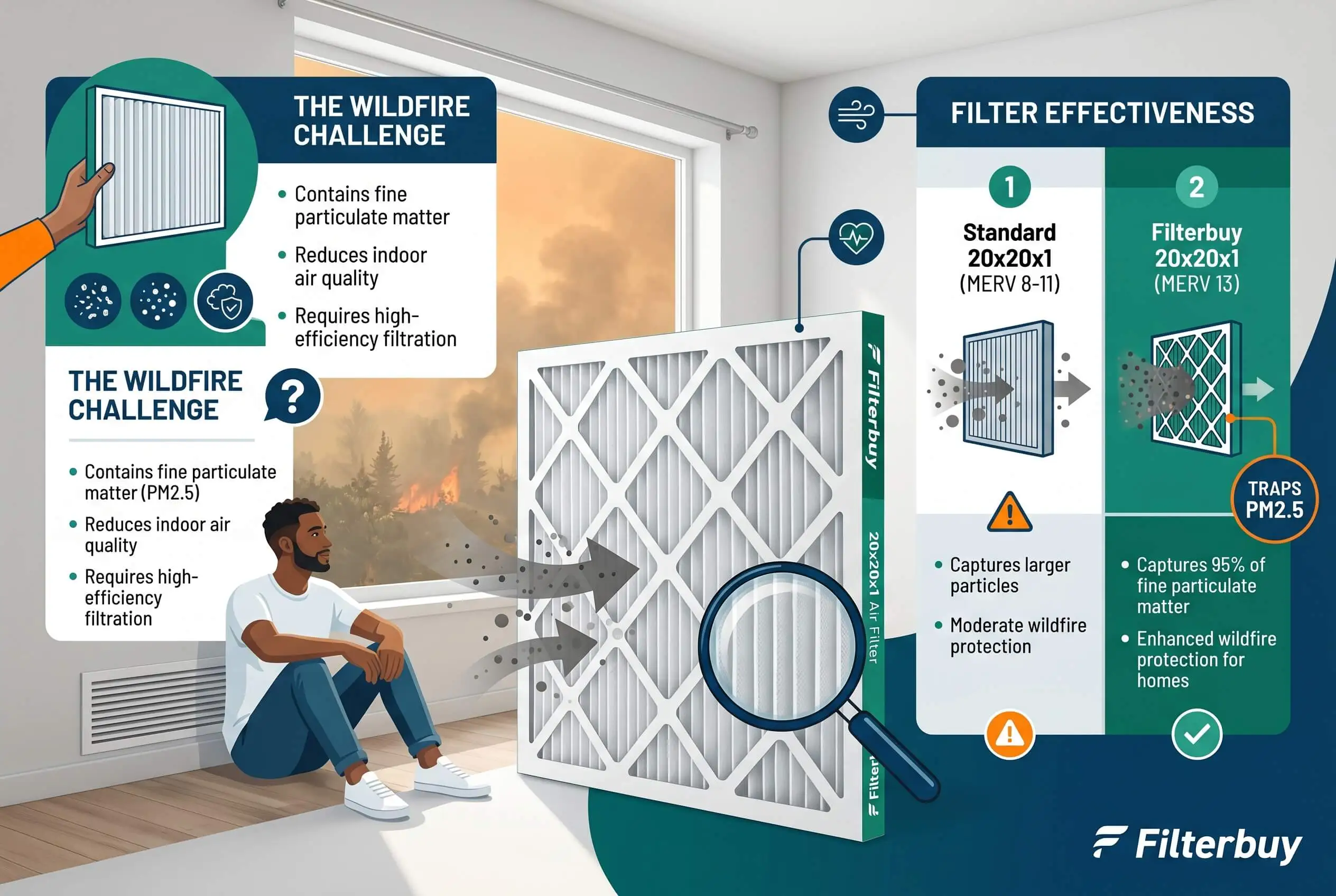
MERV 13: Fine particles including PM2.5. EPA-recommended during wildfire smoke events.
Replacement: Every 60 to 90 days under normal conditions, or every 2 to 3 weeks during sustained smoke.
Top Takeaways
A 20x20x1 air filter meaningfully reduces wildfire smoke particulates indoors, but only when it's rated MERV 13 or higher and the HVAC system can move air through it.
"20x20x1" describes the slot dimensions, while MERV describes the filter media that goes inside, and both have to match the goal.
Standard 1-inch fiberglass pads catch almost no PM2.5 and provide essentially no protection during an active smoke event.
During sustained smoke, swap the filter every 2 to 3 weeks instead of every 2 to 3 months.
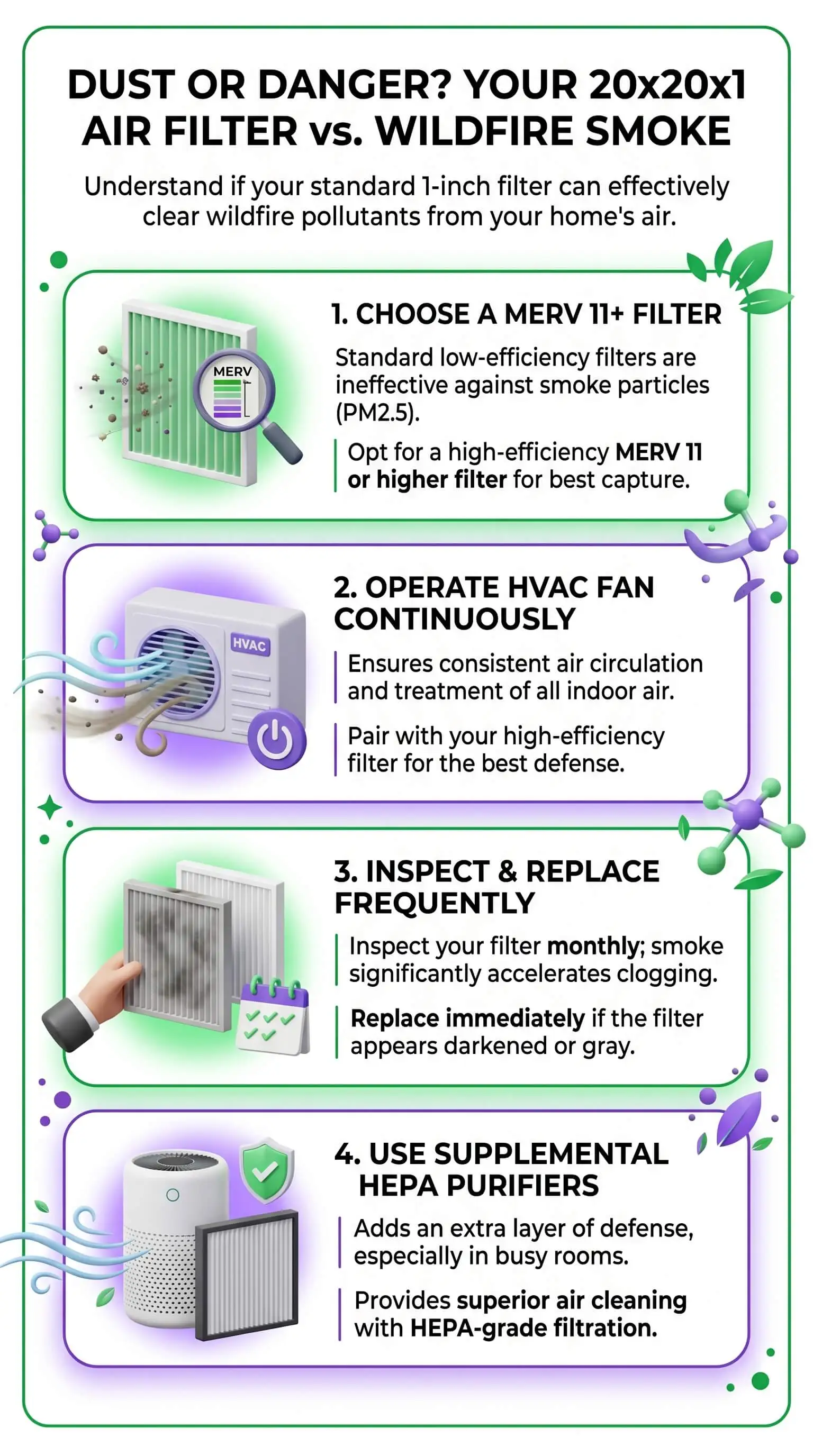
The strongest indoor strategy combines four pieces: a MERV 13 or higher filter, sealed windows and doors, the HVAC fan set to "On" with intakes closed, and at least one portable HEPA cleaner in the most-used room.
What wildfire smoke actually puts in your air
Smoke pulled into a home through return-air ducts is a mixed pollutant: fine particulate matter (PM2.5), even smaller ultrafine particles, and a gas-phase fraction that includes carbon monoxide, volatile organic compounds, and formaldehyde. About 90 percent of the particulate mass from wildfires falls into the PM2.5 range, which is small enough to cross deep into the lungs and the bloodstream. A pleated filter can catch a large share of those particles. The gas fraction is a separate problem. Mechanical filtration at any MERV rating does not capture gases, which is where carbon air filters add value by helping reduce smoke-related odors and gas-phase pollutants when paired with activated carbon and a tight building envelope.
How MERV ratings line up with smoke particles
MERV is the rating system defined by ASHRAE Standard 52.2. It measures how well a filter captures particles across three size brackets: 0.3 to 1.0, 1.0 to 3.0, and 3.0 to 10.0 microns, with higher numbers meaning finer capture. The fiberglass pad most homes ship with from the builder, MERV 1 through 4, catches almost no PM2.5. MERV 8 starts working on pollen and pet dander, but the smoke fraction passes through it. MERV 11 begins capturing some of the 0.3 to 1.0 micron particles where most wildfire PM2.5 sits, and MERV 13 is where the EPA's threshold for smoke-relevant filtration starts, with a tested minimum of 50 percent capture in that smallest bracket. For general background on how mechanical filters work, the air filters overview covers the underlying physics.
Why slot size and MERV are two different questions
The "20x20x1" label describes the slot. It tells us the filter is 20 inches wide, 20 inches tall, and 1 inch deep, which matches the most common residential return-air opening in the United States. MERV is a separate property of the filter that describes the media inside the frame, not the frame itself. A 20x20x1 can ship as MERV 4 or MERV 13, and that media choice is what controls wildfire smoke capture. So whether a 20x20x1 is "enough" comes down entirely to what's pleated inside that 20x20x1 frame.
One tradeoff matters when you go up the MERV scale in a 1-inch slot: less pleated surface area than a 4-inch or 5-inch media cabinet, so the same MERV 13 in a 1-inch frame loads faster and creates more static pressure on the blower. For most modern systems, that's manageable during the short window of an active smoke event. When you're running a 20x20x1 air filter rated MERV 13, plan to check it weekly through the smoke and replace it earlier than the manufacturer's normal cadence.
What we see in the field during active smoke
The filter color tells us most of what we need to know on a smoke-event call. A 20x20x1 that normally runs 60 to 90 days between changes turns a uniform medium gray within two to three weeks of sustained haze. Hold the spent filter up to a bright shop light and watch how little light passes through, and you can see the PM2.5 loading the media exactly the way the manufacturer designed it to. The homes that struggle most through these events share four predictable traits: pre-2000 construction with leaky envelopes, single-return HVAC setups that pull from one central location, fresh-air intake dampers left open out of habit, and an unchanged filter that was already past its replacement date when the smoke arrived. None of those is a filter problem on its own. Each one widens the gap between what the filter catches and what the indoor air actually contains.
What turns a 20x20x1 from adequate into protective
The MERV 13 filter handles particle capture. Four supporting moves close the rest of the gap during a sustained smoke event:
Run a portable HEPA cleaner sized to the CADR of the room it's protecting. Start with bedrooms, then add one in the room people spend the most waking hours in.
Set up a Corsi-Rosenthal box-fan cleaner for any large open space. A peer-reviewed 2022 study in the journal Indoor Air confirmed the design performs comparably to commercial portable units when assembled with the right MERV 13 filters.
Close outdoor air intake dampers and any economizer setting. Switch the HVAC fan to "On" so the filter sees more passes per hour, not just when the system is calling for heat or cool.
Weatherstrip the obvious leaks at exterior doors, window seals, and bath or range exhaust vents that are pulling outdoor air into the house whenever the wind picks up.
For long smoke seasons, premium 20x20x1 air filters can be a smart upgrade because they offer stronger particle capture in a familiar 1-inch format. But the one-time service call worth making is the install of a 4-inch or 5-inch filter cabinet at the return plenum. It buys more pleated surface area for the same MERV rating, drops static pressure on the blower, and helps those premium filters support cleaner airflow while stretching replacement intervals back out toward normal.
"The filter is the first thing I check on a smoke-event service call. I've pulled MERV 8 pleats out of return grilles after three weeks of haze and seen them sag at the corners from how much particulate they were holding. In homes with properly fitted air filters, especially a 20x20x1 MERV 13 swapped every two weeks through the event, the system has a much better chance of holding indoor PM2.5 readings to less than half of what we're reading right outside the front door."
7 Essential Resources
These are the seven primary sources we hand homeowners who want to read the research behind the guidance above:
EPA — What is a MERV rating? The full capture-efficiency table by particle size bracket, plus the agency's plain-language guidance on choosing MERV 13 or higher. https://www.epa.gov/indoor-air-quality-iaq/what-merv-rating
EPA — Preparing for Smoke and Heat (Wildfire Smoke Course). The clinical-care version of the smoke-event playbook, including filter upgrade guidance for vulnerable patients. https://www.epa.gov/wildfire-smoke-course/preparing-smoke-and-heat
EPA — Guide to Air Cleaners in the Home. The consumer-facing companion to the technical guidance, covering both HVAC filters and portable cleaners. https://www.epa.gov/indoor-air-quality-iaq/guide-air-cleaners-home
AirNow.gov — Wildfire Smoke Factsheet: Indoor Air Filtration. EPA-published PDF with specific reduction percentages for central system upgrades and portable cleaners (EPA-452/F-18-005). https://www.airnow.gov/sites/default/files/2021-07/indoor-air-filtration-factsheet.pdf
CDC — Evidence on the Use of Indoor Air Filtration as an Intervention for Wildfire Smoke. Literature review of peer-reviewed filtration studies with detailed reduction percentages by study and pollutant. https://www.cdc.gov/air-quality/media/Wildfire-Air-Filtration-508.pdf
Holder, Halliday & Virtaranta (2022) — Indoor Air journal. Peer-reviewed chamber study of DIY box-fan air cleaner designs for wildfire smoke reduction (PMC9828579). https://www.ncbi.nlm.nih.gov/pmc/articles/PMC9828579/
Wikipedia — Air Filter. Useful for general background on filter media types, HEPA standards, and the history of residential filtration technology. https://en.wikipedia.org/wiki/Air_filter
3 Statistics
Three primary-source numbers that frame both the problem and the response:
Wildfire smoke is overwhelmingly fine particulate. According to the CDC, roughly 90 percent of particulate mass produced by wildfires is PM2.5, the size category small enough to penetrate deep into the lungs. https://www.cdc.gov/air-quality/media/Wildfire-Air-Filtration-508.pdf
A MERV 13 filter changes the math. AirNow.gov reports that a true high-efficiency filter rated MERV 13 can reduce indoor particle concentrations by as much as 95 percent when matched to a system that can move air through it. https://www.airnow.gov/sites/default/files/2021-07/indoor-air-filtration-factsheet.pdf
Running the fan continuously helps even without a filter upgrade. AirNow notes that switching the thermostat fan from "Auto" to "On" alone can reduce indoor particle concentrations by as much as 24 percent. https://www.airnow.gov/sites/default/files/2021-07/indoor-air-filtration-factsheet.pdf
Final Thoughts and Opinion
A 20x20x1 filter helps with wildfire smoke when it's one of the top air filters, run in a smart way, and supported by the rest of the house. That means a MERV 13 pleated filter the manufacturer cleared the system to handle, swapped on an accelerated schedule through the event, with closed windows, the HVAC fan recirculating continuously, and at least one portable HEPA cleaner running in the most-used room. The same slot with a thin fiberglass pad, the fresh-air intake still open, and a filter last changed five months ago does almost nothing. That second picture is closer to the reality in most homes than the first. None of the fix is exotic. The parts are off-the-shelf, the changes are mechanical, and the difference shows up on an indoor air monitor within hours of doing it right.
Frequently Asked Questions
What MERV rating do I need for wildfire smoke in a 20x20x1 filter?
The EPA recommends MERV 13 or higher during smoke events. A MERV 13 captures at least 50 percent of particles in the 0.3 to 1.0 micron range, which is where most wildfire PM2.5 sits. If your HVAC system can handle a MERV 14 or higher without airflow problems, that's a stronger choice. Check with the system manufacturer or a licensed HVAC technician before going above MERV 13.
How often should I change my air filter during wildfire smoke?
Cut the normal replacement interval by half to a third. A 20x20x1 that ordinarily lasts 90 days will load to capacity in 3 to 4 weeks under sustained smoke. Pull it once a week, hold it up to a bright light, and replace it when light no longer passes through clearly.
Will a true HEPA filter fit in a 20x20x1 slot?
True HEPA filters, rated 99.97 percent at 0.3 microns, are almost never built in 1-inch residential slot sizes. The pressure drop would stall the blower. HEPA in the home means a portable air cleaner that sits in the room with you, while the HVAC slot runs the highest MERV the system can take.
Does running my AC make smoke worse or better?
Better, provided you switch the fan to "On" rather than "Auto" so the filter catches more passes per hour, and close the fresh-air intake damper and any economizer setting that pulls outside air. If those steps aren't possible on your system, the fan-to-"On" change alone reduces indoor particle concentrations by about 24 percent, per AirNow's wildfire filtration factsheet.
Can I tape a HEPA filter to a box fan instead?
The improved version, the Corsi-Rosenthal box, performs better than a single taped filter and rivals commercial portable cleaners for a fraction of the cost. A peer-reviewed 2022 study in Indoor Air confirmed the design's effectiveness against simulated wildfire smoke. For rooms a portable cleaner doesn't reach, it's the right call.
Set up the 20x20x1 for smoke season
Pick a MERV 13 in the slot size already cut into your return-air vent, keep two or three of the best 20x20x1 air filters on hand for the duration of the event, and swap them on the accelerated schedule above. With the right filter in the slot and the supporting moves in place, the indoor PM2.5 reading drops fast once an event arrives.